|
 Mastering
Your Music Mastering
Your Music
Why
You Need it, Where to Get it,
and How to Make the Most of
it.
by John Scott G (The G-Man), www.Golosio.com
Updated October 2010
Back to The
Academy
Mastering is widely misunderstood, often mangled, and sometimes mistaken for mixing. Still, you need it. Because once your songs are recorded and mixed, the tracks are shaped, sculpted, scooped, equalized, compressed, and finessed into sonic splendor (well, you hope) through the audio process known as mastering.
 "Mastering is what gives depth, punch, clarity and volume to your tracks," notes Matt Forger, whose name is on 200 million albums as recording engineer, mixer, and producer. After working with Michael Jackson, Paul McCartney, and countless indie artists, Forger has a unique perspective on all things audio. "Mastering is part science, part craft, and part alchemy," he says, "just like songwriting, singing, performing and recording." "Mastering is what gives depth, punch, clarity and volume to your tracks," notes Matt Forger, whose name is on 200 million albums as recording engineer, mixer, and producer. After working with Michael Jackson, Paul McCartney, and countless indie artists, Forger has a unique perspective on all things audio. "Mastering is part science, part craft, and part alchemy," he says, "just like songwriting, singing, performing and recording."
Loud
and Proud.
Contrary to popular belief, mastering is only a little about making a hotter sound. While it's true that the gain, or volume level, is boosted during mastering, it may be that raw decibels are the least critical aspect of the process. What's important is the way mastering makes songs sound. "And today," notes Forger, "mastering can be loud as well as proud."
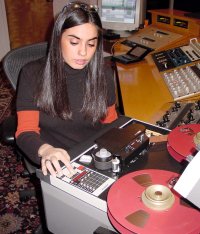 View
From The Lodge. View
From The Lodge.
Emily Lazar, of The Lodge in NYC, is both a musician and a mastering engineer. Her credits include David Bowie, Vampire Weekend, Lou Reed, Depeche Mode, The Prodigy, Jeff Buckley, Tiësto, The Shins, Destiny's Child, RZA, Morrissey, Garbage, just to name a few. "I approach mastering with the idea that music, like any other art form, attempts to touch people," Lazar says. "It tells a story far beyond that of its lyrics, if there are indeed lyrics. There are similarities between people and music -- both are often seeking a meaningful connection. That means my job as the mastering engineer is very much about making certain that the music tells a story that will resonate deep in the heart of the listener," Lazar adds.
Behind the Boards with Mastering Engineers.
Talking to mastering engineers from around the country, it is clear that they are able to make all the ultimate sonic judgments and apply all necessary aural enhancements. Mastering is where the content of your project becomes a coherent and sophisticated artistic creation. As one engineer puts it, "When a mastering engineer does the job properly, it can literally separate the hits from the rest of the market."
The
Artist's View.
Carl Verheyen is a session guitarist whose work you hear every week on hit recordings, movie/TV soundtracks, and commercials. As lead guitarist for Supertramp, and as leader of the Carl Verheyen Trio, he plays in front of tens of thousands of people each year, but at least half of his professional life takes place in studios, and he has strong opinions about the mastering process.
"Mastering is the fine-tuning and final equalization of the music for broadcast quality status," Verheyen says. "It puts all the frequencies in the correct ranges so that the bass isn't too loud, the highs don't hurt and the levels are constant with other CDs on the market."
There can be tremendous loyalty toward mastering engineers on the part of artists and producers. Michel Sembello, composer/performer of songs from hit albums and the huge film "Flashdance," once told mastering engineer Art Sayecki "After hearing what you did with 'Maniac,' you are the only person I will let master my stuff."
From
The Booth.
Larry Crane owns Jackpot! Recording and is the publisher of Tape Op magazine. He gets right to the bottom line about mastering: "It's the final stage of preparing mixes for production/replication. . . the last step in the process of making a release." Crane's advice about the decision to go to mastering: "Don't skimp!"
A
Reviewer and A&R Pro Speaks
Out.
Bernard Baur is a Contributing Editor and Feature Writer for Music Connection magazine, and in addition, serves as an independent A&R consultant. In all these capacities, he hears a lot of music tracks every month. Does mastering matter to reviewers and A&R executives? "It can matter very much," Baur states. "When you get something that obviously isn't mastered, you wonder how aware the artist is of everything they should be doing. Those artists who are 'in the game' know that they almost always need to take their recordings to the next level, and that includes mastering."
While acknowledging that the song is still of primary importance, Baur notes that, all things being equal, it's the mastered track that will tend to get the most attention. "People at magazines as well as people at record labels have gotten used to hearing a polished and fully finished recording," Baur says. "Comparisons with tracks that aren't mastered can be alarming." And mastering is being used in more situations than ever before. "Even so-called demos are being mastered these days," Baur points out.
Demo
Mastering.
"Mastering demos is becoming a standard practice in the hyper-competitive music market," notes Sayecki. It's easy to see why: record label A&R departments are deluged by demos from aspiring artists. Sayecki continues: "Mastering of demos can be an important step in giving an artist an extra edge over the competition."
Different
Kinds of Mastering.
Be certain the mastering house you select has expertise in the area of mastering you seek. Klay Shroedel is Chairmen and CEO of West Coast Film Partners Inc., an LA-based Entertainment company developing and producing film, TV, music and musical theater projects. While working with recording artists such as Celine Dion, Frank Sinatra and Sting, he also has impressive film and TV credits, including "Permanent Midnight", "Survivor," "Under Suspicion," "Jurassic park 2 & 3," "Titanic," and "Terminator 3."
"There is a basic distinction between mastering for film vs. CD," Shroedel states. "It's the dynamic range. In CD mastering, you try to achieve maximum volume without losing the dynamics, but the overall compression and db range from quietest to loudest is usually narrower than when mastering a soundtrack or a film score. The same concept of preserving the dynamic range applies when mastering CD classical releases." Shroedel will bring his experience to yet another type of mastering when launching his upcoming theatrical multimedia project.
Sounds
Great.
"Mastering is all about finesse," says Matt Forger. "You are sometimes dealing with tiny increments of equalization or compression," he states. "And it's interesting how a small change in one part of the mix can have a big affect on the total mix. But whatever you do with the mixing, mastering can take something that sounds good and make it sound great."
As production budgets get smaller, more album projects are being completed at least partly on home systems. Eddy Schreyer of Oasis Mastering points out that this "can result in lesser quality sounds. Using a major mastering facility can very often dramatically improve the final product. The mastering process increases the level and size of your recordings."
Chris Gehringer of New York's Sterling Sound has mastered projects for KE$HA and Drake as well as dozens of highly-regarded hip hop and Latin albums. Gehringer is noticing that mastering engineers are being called on to perform audio changes to tracks that "are almost like mixing assignments. Ideally, tracks are already mixed and your sonic decisions are already made when you come in for mastering. But with the advent of so much digital recording, we're getting tracks with numerous alternate mixes, lots of stems, and even various additional takes of voices and instruments. We're frequently acting as a mixer even while sonically paying attention to mastering." Gehringer notes that today's modern gear allows a lot of flexibility, which is both blessing and curse.
What
You Get.
In
almost every mastering session,
the following actions are performed:
- Optimizing
average and peak volume
levels for proper relative
loudness
- Signal
processing - compression
& EQ
- Arranging
tracks in final sequence
- Timing
of the space between tracks
- Establish
a sonic "field"
for all tracks
- Place
track markers at head of
all tracks
- Remove
unwanted noise like clicks,
pops, hiss
- Clean-up
start and ending of each
track (including fades)
- Insert
Master Track Log – the PQ
codes required for replication
Hear
The Gear.
Everybody agrees that achieving sonic perfection is an excellent goal of mastering. "When a mastering engineer and a recording artist work together, sonic perfection is exactly what can occur," states Forger, "but it is a complex process. Of course it requires a skilled professional with experience, technical knowledge, artistic ability, and dedication. It also takes great equipment."
In the mastering facilities that artists praise, there is never a total reliance on off-the-shelf equipment. "For the most part, store-bought components cannot perform the processing required by a world class mastering studio," Forger notes. "All top mastering facilities use custom or highly-customized signal processing equipment."
Here is a statement that mastering engineers and studio owners made many times with similar wording: "We design our own proprietary circuits to perform advanced signal processing tasks such as equalization, expansion, compression, noise reduction, stereo field enhancement and amplification." When pressed for details, I was told this: "By utilizing discrete, class A electronics as well as vacuum tube circuitry, our gear rivals or exceeds top audiophile equipment in terms of sonic purity and integrity."
How
Long Does it Take?
Although there is no limit to the time or money that can be spent on mastering, many people in the business state that a good rule of thumb would be an average of 8-12 hours for most albums, or in the neighborhood of an hour for each song. This assumes that the CD was well recorded and no additional processing requirements are specified. Additional time will be allocated depending on the condition of the original recording, a client's specifications and any unusual or custom needs.
The
Costs.
You can find "bargains" in mastering, but "buyer beware" is a good adage to follow. Larry Crane relates this mastering horror story. "A band received a $25 mastering job from a 'live sound' engineer who had just hooked up Pro Tools and didn't know what he was doing. The mixes were distorted, peaked with digital overs the whole time, and sounded far worse than the original mixes."
Prices from respected mastering houses vary, but you can get excellent work for $120/hour in Los Angeles. Of course, you can spend more, sometimes a lot more, but for the majority of artists, you can budget around "two dollars a minute" multiplied by "an hour per song" and be in the ballpark.
A
Little History
Bobby Hart is the co-writer of hit songs for everyone from Little Anthony, Chubby Checker, Paul Revere & The Raiders, and The Leaves to an Oscar-nominated song for the film "Tender Mercies." A top ten recording artist himself (Boyce & Hart) and producer of The Monkees, he has watched the art of mastering change over the years.
"When we started out in the sixties, the main function of mastering was to take your studio mix and compress it so your top end and your bottom end were all squished into the middle for radio. That was the main concern, just make it work for radio, meaning a mono mix for AM radio. Every studio in town had those little Auratones. In mastering, they would hardly be concerned with EQ, just with compression. Then it changed in the 70s, and from that point on, the goal was making your track sound better overall."
Hart has seen his tracks engineered and mastered by pros such as David Hassinger, Val Garay, and Bernie Grundman. "I don't know the technical side of it," Hart says, "I just know it makes the sound bigger and better."
Creative
Solutions
"In mastering, exceptional hearing and technical expertise are supported by creativity and artistic intuition," says Forger. "In order to achieve the maximum impact on the listener, certain creative elements of psycho-acoustics, psychology, use of proprietary techniques, and knowledge of the music market have to be applied in the context of the intended audience - all while recognizing the goals set by the producer and the record label."
Emily Lazar also acknowledges the intangible: "As critical as it is to maintain respect for the integrity of the music, it's just as vital to bring something new and unique to the project," she says. "Obviously, it's a balance, but finding that ideal path is one of the things that separates the work of an ordinary mastering engineer from a great one."
Fix
Your Mix.
What can you do to make your mixes work best for the mastering engineer? If you're in doubt, many mastering houses offer a free or low-cost assessment of your tracks. This is an excellent method to find out if your mix is in the proper condition for mastering, as well as one good way to see if you like the personal and/or business style of the mastering facility. But there are some guidelines to follow in preparing your mix for mastering...
"First of all," states Forger, "a good mix is a good mix. If everything is in proper perspective with good balance, then you're probably ready to go. This is assuming you haven't squashed everything with compression, of course. The same 'trick' for testing your mix that we've all used for years can work well to test a mix that's being finished for mastering: burn a CD and go play it in the car. Drive around and see if you can hear everything at a fairly low volume level. The road and wind noise acts as a filter that's ideal for testing a mix," he says.
"Don't compress your whole mix (left and right) if you don't know what you are doing," states Larry Crane. "This bus compression cannot be undone, and is one of the biggest complaints I hear from mastering engineers." Matter seconds that point: "I agree with using little to no compression on the final mix."
Forger recommends that you "Take along a CD that sounds good to you, one that has the type of frequency balance that you would like your CD to have. It will give the mastering engineer an idea of what you want your finished CD to sound like, given that it's a similar style of music, and you will have a better idea of the sound character of the speakers at the mastering studio. Mastering studio speakers always seem to sound different from what you're used to, but the mastering engineer knows them intimately."
Gehringer and Schreyer agree with Forger's idea of finding a CD with the sounds you're seeking. Schreyer also reiterates the oft-stated rule of not putting too much compression on your mixes. And he recommends you try to pay attention to the overall sound and arrangement in order to get your mix as close as you can to what you want to hear. "Train wrecks don’t master well," Schreyer notes wryly.
Many mastering engineers echo this advice: if you're in doubt about compression in your mix, do two versions, one with and one without the compression and send both to the mastering facility.
Verheyen points out: "Remember this important fact and you'll be safe: The mastering engineer can NOT mix your record. They do not deal with individual track levels, only frequencies. But if you come in with great sounding tracks, he or she will only make them sound better!"
Expert
Advice.
Some mastering engineers will try to make time to assess your tracks and advise you on potential mixing decisions you might want to make. "I listen to tracks all the time and let people know my opinion of their sonic situation. Different genres of music have different needs and each artist may have a unique goal. Just taking a few minutes to discuss it can save you time, energy and cost later," Forger says.
Lotus Mastering owner Michael Hateley got his start as a mastering engineer at Warner Bros. Records and now owns his own studio. Hateley's credits include Green Day, Built To Spill, Mastodon, Slayer, Jaheim, Neil Young, NOFX, and The White Stripes.
Hateley feels that the key to achieving good mastering is in communication. "I try to get into the head of the artist," he says, "to discover what they want from the song or from the project." He will often master one song for the artist to review before moving on to the rest of the project.
"I don't try to put my fingerprint on the artist's work," Hateley states. "As a mastering engineer, I think my goal is bring out everything the artist is aiming to create. I want to make the music work; the mastering house should have the least amount of intrusion possible while crafting the right sound."
As for delivering a song or album for mastering, Hateley does not have different advice for indie artists vs. signed artists. "Record and mix to get it as close to what you want as possible," he notes. "Get as near as you can to perfection in EQ and tonality, then let me take it the last few yards. Just try to leave me from 3 to 6 db of headroom so I've got something to work with."
Bottom Line.
"When it comes time to present your recordings to the world," says indie artist Olivia Duke, "you just have to find a mastering engineer you respect and trust." Duke already has had some of her songs utilized on television soundtracks. Did she follow all the advice in this article? Absolutely. And did she master her tracks even though they are not yet part of an album? You bet. Why? "Sometimes," Duke points out, "mastering can be everything."
MASTERING
STUDIOS
Here are some people and places involved in mastering. These names are often mentioned when talking to artists and others in the industry about quality mastering engineers and great sonics.
Matt Forger
www.studioexpresso.com/profiles/MattForger.htm
www.indiepromix.com/mattforger.html
Capitol
Mastering
Robert Vosgien;
Ron McMaster; Mark Chalecki;
Bob Norberg
1750 North Vine
Street
Hollywood, CA 90028
323-871-5003
Digital Domain
478 East Altamonte Dr #108-122
Altamonte Springs, FL 32701
407-831-0233
Gateway
Mastering & DVD
Bob
Ludwig
428 Cumberland Avenue
Portland,
Maine 04101
207-828-9400
Bernie
Grundman Mastering
1640 N. Gower St.
Los
Angeles, CA 90028
323-465-6264
The
Lodge
740
Broadway, Suite 605
New York,
NY 10003
212-353-3895
Michael Hateley
Lotus Mastering
323-252-8385
michael@lotusmastering.com
The
Mastering Lab
911 Bryant Pl.
Ojai, CA 93023
805-640-2900
Oasis
Mastering
4109 West Burbank Blvd.
Burbank, CA 91505
818-567-0500
Sterling
Sound
88
Tenth Avenue
6th Floor West
New
York, NY 10011
212-604-9433
Additional
Sources of Information:
Tape Op Magazine
"What
Happened To Dynamic Range?,"
by Bob Speer.
Book:
Mastering Audio: The Art and
The Science by Bob Katz
----
John Scott G is managing partner of Golosio Publishing. As "The G-Man" and "Jonny Harmonic," he has 10 albums on iTunes. He is co-writer of "Bad Actor" on the Merle Haggard album "I Am What I Am." Read/hear what he's up to at: www.golosio.com
|