|
What's a Record Label Deal All About?
by Christopher Knab - Fourfront
Media & Music
Updated
April 2010
Back to Music
Business 101
It is my experience that most musicians think they want a record deal, but know nothing about these ominous 80-100 page, single-spaced recording contracts.
Recording contracts are legally binding agreements between artists and/or bands and a record label. These contracts, when signed, commit the act and the label to certain obligations.
So, in this digital age when fewer and fewer Major Labels are signing new talent, and what they sign and release is selling poorly, labels these days are more demanding than they were in past decades, when it comes to signing anyone.
Record labels today are attracted to acts that have built a strong following and have proved to the industry that they are a solid investment. When a record label signs an act to a recording contract, they expect to make a substantial return on the financial investment they have made in that act.
The following information is provided to you as a basic outline to the key parts of a recording contract. Please be advised that should any such contract ever come your way, never sign anything without consulting your entertainment law attorney.
INDIE LABEL VS. MAJOR LABEL
Indie Label (See
Also, Major Label)
By the purest industry definition, an independent label is a record label that is not affiliated in any way with a Major Label, and uses independent distributors and/or digital distribution methods to get their releases into stores, both online and into the traditional brick and mortar music retailers.
Note: For an in depth article on the types of relationships that exist between independent labels and major labels see the chapter I co-wrote with entertainment law attorney Bartley F. Day in the excellent resource book The Musicians Business and Legal Guide, 4th Edition, published by Prentice Hall.
When you think about pursuing an independent record label deal, think about the following issues:
DISTRIBUTION
Make sure the label has a solid distribution deal on a national level. Be sure to check on the relationship between the label and their distributor(s). Ask some questions like:
- How many CDs has the distributor sold of the label's product?
- Did the label have any problems getting paid by their distributor?
- What kind of working relationship do they have with their distributors
on their new releases?
- Does the label have a budget to pay for some co-op ads, and in-store
promotions through their distributor?
- What kind of Internet distribution and online sales methods does the label use?
ROSTER
Make sure the label's roster isn’t too big, or else you won't be given the attention you deserve. Also, make sure the acts on the roster match the type of music you play.
PUBLISHING
If the label has an affiliated Music Publishing division, and wants part of your publishing, don’t be surprised, but be sure your attorney protects as much of your publishing royalties as possible. Never allow a label to recoup any monies advanced to you for the recording of your record from your mechanical royalties. (This is the money owed to the songwriter and music publisher of the songs you wrote on your record, for the sales of your record.)
MERCHANDISE
Merchandise deals are deals made by your attorney outside of your recording contract, for your likeness to appear on t-shirts and other clothing and objects. If the label wants a percentage of the income from such a deal, you may have to negotiate how much they get.
OPTIONS
Find out how many options the label wants. Since “options = number of records (CDs),” you don’t want to agree on too many options.
INDIE PROMOTERS and/or IN-HOUSE STAFF
Find out if the label works with independent radio and/or retail promoters. It’s a good sign when they do; this raises the chances that your record will be seriously and effectively promoted.
ADVERTISING
Find out if the band has an advertising budget for releases.
TOUR SUPPORT
Find out if and how they support you on your tour (financially, morally, etc.) and how much of any advances for touring are recoup-able.
POINT / PERCENTAGE of the LIST PRICE You Receive
Find out how much you get paid for each record sold. A new act usually gets somewhere between 10-15% of the suggested list price of a recording. (Remember too that out of your percentage, you must pay your producer their percentage, for producing your record.)
Major Label
By industry definition, a major label is a label that commands a high percentage of the annual sales of records, and has their own distribution system. (The Big 4 distribution companies currently are: WEA, SONY/BMG, UNIVERSAL, and EMI. Please note that at the time of this writing - April 2010 - EMI is probably going to be merged or bought out by either Sony or Universal, so keep your ears to ground for any updates on this important issue. We soon may be down to The Big 3 Labels!)
When pursuing a major label deal be absolutely sure that this is what you really want. Here are some points that might help you determine if this is the right thing for you to do:
OPTIONS
A major label often signs artists for six to eight "records" (CD releases), not years).
A&R
Research the A&R person. Know whom they’ve signed, who they’ve worked with, who they’ve worked for, and how long they have been employed.
NUMBER OF RELEASES
Find out how many records the label releases per year. You don’t want to sign with a label that releases too many records. Remember, they only have so much time and enthusiasm to put into the promotion of each record. Many major labels have between 12-25 releases coming out each month.
Here are some clauses that you will encounter (and sometimes have to watch out for) in a contract with a record label:
EXCLUSIVITY
Every record contract includes a provision stating that the deal is “exclusive.” In other words, during the term of the agreement, you can’t make records for anybody else. Therefore, an exclusivity clause in a contract refers to the fact that you may only contract with this record company (you are “unilaterally married” to that company.) I strongly recommend that your attorney define the extent of exclusivity.
TERM
The duration of the contract. (How many records? Any time constraints?)
PRODUCT / CREATIVITY
Who will control the amount of product and the quality of the product? You always want as much creative freedom as possible; the record company often maintains a veto power when letting a band choose the producer, engineer, studio, etc.
RECORDING COSTS
How much (recoupable) recording money will you get? Don’t overdo it! Remember, you will have to pay it back from your royalty rate as applied to actual sales.
ADVANCES
How much (living) money will you get that is recoupable? What about other advances, such as videos, and touring? Remember, you will have to pay back that amount to the label.
ROYALTIES
The money paid for your service as recording artists. Outside of U.S. is calculated differently. (Canada: 75–90% / UK, Japan, Australia: 60–70% / Rest of the world: 50 % – of U.S. rate).
VIDEO
Who controls the music video and how the costs are apportioned. Try to have only 50% of the cost recoupable.
PUBLICITY
The label will need your permission for name, likeness and voice in order to publicize your record. Also, ownership of your website URLs may also be a point of negotiation.
MERCHANDISING
Same as with Independent labels.
UNION
Your promise to join a union (AFTRA, AFM).
AUDITING
Your right to audit the books. Make sure this clause is included in the contract.
ACCOUNTING
The label’s responsibility is to report financially to you (reports to artists usually occur every six months; i.e., if an accounting period lasts from January till June, the label will report to the artists approximately in September).
ASSIGNMENT
The record company’s right to sell the contract. Majors sometime shuffle acts around from one affiliated label to another within their family of labels.
CONTROLLED COMPOSITION
How the label will pay mechanical royalties. Standard practice is that the label will only pay on 10 songs on your record, and at 75% of the current statutory mechanical license fee. (As of 2010, 9 cents per song, per unit sold.) This rate changes every two years.
TERMINATION
This clause specifies the songs you may not be allowed to record for a set time after the ending of the contract.
SIDEMAN'S CLAUSE
You might want to consider including a sideman’s clause. A sideman’s clause allows an artist to do studio work. The artist still needs permission from the record company; they however, can’t say no unless they have a very good reason. Under normal circumstances -- without such a sideman’s clause -- you would be prohibited from performing for any other band/label under the terms of an exclusive contract. If you have a sideman’s clause in your contract, make sure all members of your band sign the document.
KEY MAN CLAUSE
If a significant label executive resigns, or leaves the company, you may terminate the deal. The label may also put such a clause in concerning a band member.
I hope this information was useful for you. Knowing some basics about the realities of recording contracts before you get involved with them can save you a lot of grief down the road. Remember, record company lawyers have a reason for every clause in their contracts — so should you.
-----
Christopher Knab is an independent music business consultant based in Seattle, Washington. He
is available for private consultations on promoting and marketing independent music, and can be reached by email at: chris@chrisknab.net
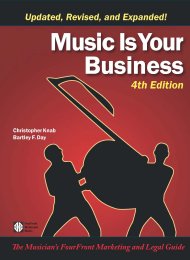
Chris Knab's new book, 'Music Is Your Business'
is available NOW from the Music Biz Academy bookstore.
Visit the FourFront Media and
Music website for more information on the business of music from
Christopher Knab.
|