|
 10
Essential Tips for Making 10
Essential Tips for Making
a
Living with Your Music
by Christopher Knab - Fourfront
Media & Music -
Updated April, 2010
Back to The Academy
Everybody loves Top 10 Lists, from David Letterman's countdowns, to the Huffington Post's top 10 this and that. It’s a fun way to maintain the illusion that in a complex world, things can be simpified, or dumbed-down.
So...Let's play along. Why not a Top Ten List on the subject of Making A Living From Your Music?
The following list highlights 10 habits you should develop if you want to make a consistent living from your music. I can honestly say that these habits are the habits of successful musicians I have known and admired:
1)
Find ways to get ordinary people
who love music, to love your
music. We live in a time when everybody and their sister can and does make their own music. That doesn't mean, however, that your music has what it takes for record labels to invest their money and time developing, promoting, and marketing that music.
Try your music out on "music fans" in the same way you would solicit opinions from A&R Rep. Talent scouts in the music industry are always following tips they hear from their street connections. But remember, your music must truly stand out in some significant, original, dynamic, and creative way. 95% of the independently produced CDs out there contain regurgitated ideas that were ripped off from some other more gifted musicians.
So prove to the industry that ordinary music fans in your city love your music.
You can do this by giving away samples of your music and putting some of your songs on the many internet websites that allow people to download or sample new music. If people love something they let other people know about it. So, you can find out quickly if your music has what it takes to please the public by giving away your music, for a while, until there is a real demand for it. Then continue to give away your music, but in a more controlled or limited way.(Perhaps give away a song or two for a limited time on you website, or through MySpace and/or Facebook.) You will sense when the time has come to control this habit and charge a reasonable fee for access to your music.
2)
Play live often and don’t worry
( at first) about getting
paid for every gig. You can always tell the difference between a musician who is in it for the money, and a musician who is in it for the music. The dedicated musician can’t not play music every chance they get. Money-focused musicians whine about the fact that they can't get club gigs that pay anything. If you really think that you can make your living solely as a musician in the first three to four years of your career, you are headed for a breakdown and disappointment. Think about it... almost every legendary, gifted musician who has made a mark on our culture has been a musician who struggled long and hard at their craft, and never gave up. Eat determination for breakfast! Go out there and play on the streets if you have to, play at schools, fairs, festivals, do benefits to help other people and organizations. Offer your services to non-profits, charities, church groups, and any other companies or organizations you can think of. Hang out at clubs, look for jamming possibilities, or start your own jam sessions. Look around your city or town, and you will see many places and venues where musicians can play. As you establish yourself and more and more people show up at your shows, the paid gigs will increase. Remember... play live, and then after you play live, play live again, that’s what musicians are supposed to do.
3)
Know your instrument inside-out. One of the curious developments of the late 1970’s was the huge increase in garage bands, punk bands, rappers, and "do-it-your-self-ers", who just picked up an instrument, or started to sing with some friends, and 6 months later recorded a record and began to play live. Some great music, and new directions in music, came out of that situation. But now, 30 odd years later, the novelty of hearing amateurish thrashings has gotten a bit dull.
Prior to late 70’s, more often than not, the music that is our heritage was made by musicians who, from the time they took up their instrument, worshiped at the feet of some master bluesman, jazz player, folk legend, songwriter, or whatever. The habit of these inspired musicians was an appetite for perfection. A need to be not just "good enough", but GREAT. Why settle for less? Whatever developing stage you are at, go beyond it, re-commit yourself to your instrument or voice. Take lessons, or better yet, sit yourself down at your CD player and choose a favorite musicians record, and listen closely to what they are playing. then re-play it, and re-play it again. Challenge yourself to go beyond your limitations. Who knows, maybe you will fall into some new territory, wherein you will find yourself, your "sound", and increase your chance to stand out from all the mediocrity that is your competition.
Believe it or not, record labels love to hear innovative, accessible new sounds. Actually in their heart of hearts, that is what they are really hoping to hear on every new demo, and from every new act they go see at a live venue. You see, in the business of music, when we hear something new, original, and accessible to people, we can then invest in you with more security, believing that if we put our "label brand" on you, with our talents of promotion and marketing coming to the front, then we "have something", and your music becomes our music, and we work together to broaden you audience appeal. It’s kinda like a partnership... something about "Art and Commerce"... they can work together you know?!
4)
Protect your investment... register
your songs for proper copyright
protection. I never cease to be amazed how few artists are willing to spend $40 to register their songs with the Copyright office. By the way, these folks are often the same folks who complain about not getting paid to perform their unknown music. All I know is that when an inventor comes up with some new product that they think will appeal to a certain type of customer, the first thing they do is file for a patent on their invention. The same reaction to protecting songs should be there for any serious songwriter. If you really intend to work hard and develop your career as a musician who writes your own songs, don’t wait too long to take care of this simple, but essential task. If you really believe in your unique and original music then take the time to learn the basics of copyright protection. From the Internet to the library, there's an easy way to learn what it takes to file for copyright protection. Do it now! Go to www.copyright.gov
5)
Design and write your promotional
materials so they stand out. The topic of designing and writing effective promotional materials; bios, fact sheets, cover letters, quote sheets, website and blog pages etc. is a lengthy one to say the least. As far as some tips that can help musicians promote their careers, and contribute to their getting any deal offers, is to make the promo materials as compelling, and informative as possible. Take the time to inventory any accomplishments, positive reviews, training and awards, past sales, and live appearance highlights; and organize them into professional written documents that you have saved for you website, MySpace and/or Facebook accounts. Having done that, time also needs to be taken to research who to send the materials to, and to ask each potential recipient what type of information they would like to have sent to them. No "generic" kits should ever be created. let alone sent to any gatekeepers in the music business.
6)
Know the labels and music publishers
you hope to be signed to. If you were applying for a job with a certain company of corporation, wouldn’t you take some time to ask questions about their stability as a business, their reputation in the industry, and the executives background and experience? The same is true when you are approached by any reliable music industry company. Some musicians get so excited when a certain label approaches them with a recording contract offer, or a publishing company offers to sign them. Being approached for a deal is a compliment and recognition by a label or publisher that a musician’s music is attractive to them. But, to rush ahead without taking the time to learn a few things about them is foolish indeed. Ask... how have they done with your particular genre of music? What specific "points" are they offering you? Who runs the label or publishing company? What is their reputation in the music business? How do you like them as people? These and other questions can be crucial in making an unemotional decision about an arrangement that could make or break your career.
7)
Have your own ‘Entertainment
Law Attorney’ to represent you. The business of getting signed to any deal in the music business has always had, has now, and will always have, the involvement of entertainment law attorneys. No jokes will be inserted here, because any relationship between a musician, a record label, a publisher, a merchandiser etc. will come down to two attorneys hashing out the contract for the musician and the respective companies involved. It should be pointed out here that when all is said in done with the "courting" process, the musician is never present during the actual negotiations. The musicians attorney and the music company’s attorney meet, talk over the phone, and fax/email or snail mail their offers and counter-offers amongst themselves. This fact serves to remind you that choosing a reputable, ethical, well respected attorney with lots of deal-making experience within the music industry is an absolute necessity for any serious musician who wishes to fight the good fight in the legal arena.
8)
Choose a well-connected and
respected personal manager. Great artist managers are becoming a thing of the past. Self-management is always a valid option in the developing stages of establishing your career as a musician. Much can be learned by taking on the jobs of securing gigs, getting some publicity, planning tours, dealing with personal issues that arise within the band, and schmoozing with A&R Reps and various other label and publishing personnel. However, there comes a time, usually when the daily tasks of doing the business of being a band takes up too much time, and it is at this time that the services of a good manager can be very useful. I have always felt that if any musician or band has worked hard to establish their career, and achieved a modicum of success, they will have a better chance to "attract" the services of a professional, well-connected and respected manager.
Managers who do this job for a living can only take on clients that generate income. Making money as a personal manager is no easy task, and many upcoming artists forget that if any monenies are to be generated from their music, it can takes years for the flow of that income to be reliably there. So, as a band develops self-management, or gets help from intern/student manager-wannabees, this can help pave the road for professional management.
Over the years I have heard several horror stories about "managers" that approach upcoming acts and say that for X amount of dollars, they can do such and such for the artist. No... this is not the way legit personal managers work. Well-connected and respected personal managers get paid a negotiated fee for their services (get it in writing) for any and all business transactions they are responsible for (15%-25%) over a particular contract period. No musicians should ever pay a fee to a so-called "manager" who will not do any work UNLESS they are paid up front. Flim-Flam men and women still abound in this business... be forewarned.
One of the most important jobs of a manager is to secure recording and publishing contracts for their clients, this is why it is so essential to choose well connected and well respected managers. The music business is a "relationship" business. Who know who, and who can get to know who, and who did what successfully for who... is what this management game is all about. Choose carefully those people who will be representing you in any business dealings.
9)
Don’t take advice from anyone
unless you know that they know
what they are talking about. At the beginning of this article I stated that these 10 tips were just my comments from years of dealing with the business itself and many musicians. Everybody has their own list of Do's and Don'ts and the only real value they have is that they present you with "opinions" about what to do to get established as a musician.
To be quite candid, the best rules in the music business comes from the experience of building your own career; learning from your own interactions with the gatekeepers at labels, the media, management, and booking companies as to what is right or wrong for you. For every Do or Don’t there is an exception to a so-called "rule". As I reflect on the advice I sought out and listened-to over the years, the most valid tips came from people who walked the walk, and talked the talk. If you feel that the source you have contacted knows what they are talking about, and has had first hand experience doing what you want to learn about, that is the only feedback that might stand up over time. Choose carefully.
10)
Musician...Educate Thyself!
If you want a record deal, learn
what a record deal is, and learn
something about the business
of music. Naive or mis-informed musicians are a menace to themselves. Enough already!
Over the decades there have been countless stories of musicians who were ripped off by their record labels and music publishing companies. Why? Exploitation was the name of the game for a long time. Keeping musicians in the dark was standard business practice. However, the past has passed, and today any musicians who sign a record contract (and learns later what he or she signed) have only themselves to blame. Even 20 years ago, it wasn’t that easy to gain access to the inner workings of the music business. (There are more letters in the word business than in the word music.)
Today there are dozens of outstanding books available on every conceivable topic related to the business of music. They can be found in bookstores, libraries, and through the Internet. In addition, there are many schools that now offer 2- 4 year programs on the business of music. Seminars, and workshops are available on a year round basis in most major American cities. Consultants, Attorneys, and Business Organizations are all around and so it is only myth, superstition, stubbornness, and immaturity that stand in the way of any musician making a commitment to educating themselves about the business that exists to exploit their music.
I cannot stress how important I feel this issue is. I am here to tell you, one and all, that you have been told many things about music that you did believe. "Spend money on quality instruments and equipment"... you have done that. "Spend time and money on practicing and rehearsing", you have done that, for the most part."Spend time and money finding the best recording studio, producer and engineer you can"... you have done that. "Spend time and money learning all you can about the business of music"... well, no one told you to do that did they?!
It has been said about education that we don’t know anything until someone tells us. If that is true, the fault in "not telling" musicians that they MUST spend some time and money on educating themselves on music business issues is the fault of the businessmen and women who kept their clients uninformed. (Ignorance IS bliss as far as the old guard of music executives are concerned). But, KNOWLEDGE IS BLISS should be the byword for the musician of the new millennium. Please...spend some time and money educating yourselves about the music business, a few hours now, can protect your future forever!
-----
Christopher Knab is an independent music business consultant based in Seattle, Washington. He
is available for private consultations on promoting and marketing independent music, and can be reached by email at: chris@chrisknab.net
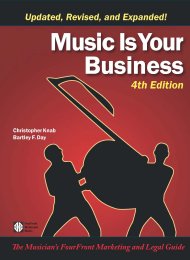
Chris Knab's new book, 'Music Is Your Business'
is available NOW from the Music Biz Academy bookstore.
Visit the FourFront Media and
Music website for more information on the business of music from
Christopher Knab.
|