|
 Copyright and Songwriting Basics Copyright and Songwriting Basics
by Christopher Knab, Updated January 2008.
Back to Music
Business 101
How exactly to you go about registering your copyrighted songs? Is it even necessary? Here's
a brief explanation of the process and the terms:
- Copyright protection is acquired automatically when a work is "created".
The definition of "created" is when a work is fixed in a copy or recording for the first time.
- However, Proof of ownership and copyright is achieved by registration of the copyrighted song.
This is done by filing your songs with the U.S. Copyright Office and using either Copyright form PA or form SR, The registration fee for a song is $45, and you should also send one copy of the unpublished song on a record, tape,
CD, or lead sheet. If the song has been published, two copies are sent. Registration becomes effective upon receipt
of the application form, copies of the song, and the fee.
- Registration of songs is necessary in order to protect a song from being used without
permission, and is necessary to present in a court of law and to sue for copyright infringement. It guarantees
legal protection.
- Copyright forms PA and SR (explained below) can be found in many published
books, or may be obtained from the copyright office:
Copyright Office, Library of Congress
Washington, DC 20559
or Download them here.
- Put a copyright notice on all published copies of the song. A circle with a small 'c' [©] in it is the
usual mark, but the word 'copyright' is also acceptable. Follow the mark with the year and the songwriter's name.
Note: the year stated is the year the song was 'first published', not when the song was written. Unpublished works
need no copyright notice, but it is still a good idea to put the mark and use the phrase, for example "unpublished
2008, James Jones".
- A copyrighted work has protection under the law for the life of the
songwriter, plus 75 years after his/her death.
- Song titles are not copyrightable.
But be aware that using the exact title of a song that has established itself as part of the culture, can open
the doors for a lawsuit based on property rights in the title, which belong to the copyright owner of the famous
song.
- The sound recording copyright (registered with form SR) is for the protection of the
sounds on the
recording, and usually belong to the record company who has released the CD or tape. The PA copyright form is the
copyright of the work
on the CD or tape, and usually belongs to the Publisher of the song. If the same
person owns the recording and the song, use one SR form.
- The Mechanical rights and the Performance rights to a song are the two separate rights granted to the owner of the song. Mechanical
rights are given in order to reproduce the song on actual CD's and tapes, and to sell the reproduced copies to
the public. It is the responsibility of record labels to pay mechanical royalties to the owner of the song, for
the sale of CD's or tapes.
- As of 2008 the mechanical royalty rate is 9.1 cents per song, per CD or tape sold. Adjustments to this rate are made every two years. Additional rates apply for songs over 4 minutes.
- Performance rights
are granted in order for the song to be sung or played (recorded or live), in a public place or on radio and television.
It is the function a Performance Rights Organization (ASCAP or BMI) to grant these licenses and pay the owner of the song for
the use of the song on the radio, TV, hotels, clubs, colleges, some restaurants and bars, elevators, doctors offices,
stores, etc.
- A song that is reproduced on a soundtrack for a film or a TV show is
called a synchronization, and the film or TV producer must secure a synchronization license from the owner of the
song. (commonly called a 'synch' license.)
- Two other sources of income for a songwriter and publisher are sheet
music sales, and songs used as jingles or ads.
With the advances made on the Internet for 'streaming' or downloading music, you should check with www.Soundexchange.com
-----
Christopher Knab is an independent music business consultant based in Seattle, Washington. He
is available for private consultations on promoting and marketing independent music, and can be reached by email at: chris@chrisknab.net
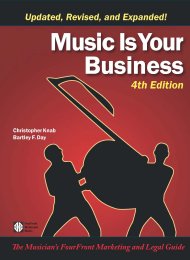
Chris Knab's new book, 'Music Is Your Business'
is available NOW from the Music Biz Academy bookstore.
Visit the FourFront Media and
Music website for more information on the business of music from
Christopher Knab.
|