|
 Performance
Royalties Performance
Royalties
Copyright August
2007 by Keith Holzman,
Keith
Holzman Solutions Unlimited.
All rights
reserved.
Back to The
Academy
For years radio airplay was the primary method for marketing almost
all
genres of music. Although that's no longer strictly the case, what's
remarkable is that recording artists and record labels have never received
any form of payment for this usage -- not a single penny! Yes, publishers,
songwriters and composers receive compensation via annual fees paid to ASCAP,
BMI, and SESAC by radio stations. These fees are then apportioned to
publishers based on the number of times songs are played as logged by the
stations and monitored by the performing arts societies.
But no
performance royalty to labels and artists has ever been paid in the U.S. for
over-the-air broadcasts, and this situation has existed for many decades, in
fact since the first commercial broadcast in 1922!
Let me digress for
a moment.
Popular music has always received some form of radio play, but
until the 1940s it was fairly negligible. A lot of radio was network-syndicated
comedy and variety shows, with occasional radio dramas.
Smaller stations used transcription disks, and most of the music
broadcast was from "live" orchestras and dance bands. In the mid-1950s,
when radio was threatened by the rise in television viewing,
stations started relying increasingly on playing pop music to garner
listeners.
1955 saw the development of the Top-40 format at a station in
New Orleans. What was unique was that the most popular songs were the ones
they would play most often. The idea caught on and was quickly adopted by
many stations throughout the country. The last half of that decade saw a huge
increase in radio station profits and concurrent sales of phonograph
records.
The resulting symbiotic relationship of radio airplay and
record sales was great for both industries, but over the years stifled a
lot of creativity because labels tended not to record or release
music that they didn't think would or could get played on the radio.
Many labels' talent signings were thus indirectly and
inadvertently controlled by the broadcast industry.
End of
digression.
Last month, an organization was formed that calls itself the
Music First Coalition. This strange assortment of bedfellows
includes SoundExchange, the RIAA, the American Federation of Musicians and
the Christian Music Trade Association. Founding artists include the
Dixie Chicks, Brian Wilson, Aimee Mann, Los Lonely Boys, Judy Collins,
Don Henley, Tony Bennett, and John Legend. They want radio stations to pay
performance royalties.
Their website statement pretty much says it all:
"For 80 years, Corporate Radio has refused to compensate artists when they
play their songs on the radio, even though radio makes billions on
ads from listeners and music fans."
Since 1995 the U.S. Copyright
Office has authorized SoundExchange to collect and distribute digital
performance royalties for recording artists and record labels when their
sound recordings are performed on digital cable and satellite television, the
internet, and satellite radio. Remarkably, this doesn't include
over-the-air broadcasting.
On July 31st, at a hearing of the House
Judiciary Subcommittee on Courts, the Internet and Intellectual Property, its
chairman, Rep. Howard Berman (Dem.-California), said he plans to deal with
this matter by writing legislation that would pay record labels
and performers for music played on the radio. "I've wanted to hold
a hearing for a very long time, not only because of my constituents
but because as a policy matter it is time for Congress to re-evaluate
the limitations of the current performance right for sound
recordings. I will come right out and indicate my bias -- I have supported
the expansion of the performance right for over 20 years, with
two caveats: one is that by extending this right it does not diminish
the rights and revenues of the creators of musical works and second,
that terrestrial broadcasters, large and small, remain a viable source
of music"
The United States -- along with China, North Korea and the
Congo -- is one of the few countries that exempts over-the-air radio
from paying a royalty to performers. That's some company to be
in!
Radio stations in almost all other major nations do pay
performance royalties, but some countries are withholding payment to
American performers to protest the lack of payments made to foreign
artist whose music is played in the U.S. These countries include
Canada, Japan, Australia, and all of Europe!
Marybeth Peters, the
Register of Copyrights, told Berman's committee that changes needs to be
made, not only to make American law fairer, but to allow artists and labels
to recoup royalties from other countries. She indicated that, despite strong
efforts since 1976 to include a performance right in the Copyright Act, it
wasn't done, a fact she attributed to the "effectiveness of the broadcast
lobby."
"The U.S. has limited its obligation for protection to only
certain digital transmissions and specifically has exempted
over-the-air broadcasts," said Ms. Peters. "The United States stands out as
the most prominent industrialized country without this protection,"
and estimated that American labels and performers lose about $70 million
a
year in potential foreign performance royalties.
Charles Warfield,
president of ICBC Broadcast Holdings called performance royalties a "tax" on
listeners and urged the committee to keep the status quo. He contended that
the promotional benefit performers and labels get from airplay is more
valuable than cash.
Apparently few committee members appeared to buy the
"tax" idea and seemed offended that the broadcast industry would make such a
claim. "This is patently not accurate," said Rep Sheilah Jackson
Lee
(Dem-Texas.)
Luckily for record labels and performers, Berman is
expected to present a bill this Fall, while a similar bill is expected in
the Senate.
I
emphatically agree that compensation for recorded performances should be paid
to artists and their record companies. But what might happen if such
legislation does not make it through Congress? What then? Will it be
necessary for labels to boycott stations and no longer provide them with free
promotion copies? Is that even legal? What would prevent stations from buying
music and playing it on the air?
I asked my colleague, William
Hochberg of High Mountain Law, if record labels could legally withhold their
music. "It's doubtful," he replied. "ASCAP, BMI and SESAC issue blanket
licenses, allowing broadcasters to play massive catalogs of songs, amounting
to virtually the entire American repertoire. They are within their
right to broadcast without limitation as long as they pay for the
blanket license, and the courts will not currently recognize any
additional obligation to pay a sound recording royalty for terrestrial
radio."
At a 1975 NARM convention in Los Angeles, Stan Cornyn, then
senior VP of Warner Bros. Records, gave a now-famous and off-quoted
keynote speech titled "The Day Radio Died." In it he posited what
would happen to the record industry if radio stations no longer
broadcast any music. He said "As an industry, we have committed the
unnatural act: we have become, year by year, so dependent on radio exposure
of our records that -- without that play -- we're cooked. In the last ten
years, and dramatically in the last five" (remember this was 1975) "the
record business has sold only what it could get played."
Stan then went
on to ask "Do we, as an industry, really want to
confine our sales only to
records that can get frequent airplay. To be almost totally dependent on
another industry, which has very different goals than ours, to do our
marketing for us."
Broadcasters, then and now, play the songs that they
think will deliver to them the greatest quantity of "ears." And they only
want those "ears" that are the most likely to buy their
sponsors' products. These broadcasters are in business to make as much money
as possible for their stockholders and they often do it on the backs
of record labels and their artists.
What would labels do to market
their "product" without this key, and often taken for granted, tool? If
labels and artists decided to withhold their music from broadcast -- and if
it's legal to do so -- we could get to the point where we may just find
out.
In any event, it's imperative that all labels,
particularly independents, develop all possible alternative approaches to
market their music to the public, while encouraging their senators
and representatives to pass effective performance royalty legislation.
~~~~~~~~~~~~~~~~~~~~~~~~~~~~~~~~~~~~~~~~~~~~~~~~
Copyright 2007 by Keith Holzman, Solutions Unlimited. All rights
reserved. Adapted from "Manage for Success," Newsletter #76,
August 2007.
~~~~~~~~~~~~~~~~~~~~~~~~~~~~~~~~~~~~~~~~~~~~~~~~
Keith Holzman is the principal of Solutions Unlimited, a management
consultant specializing in the recording industry. A trusted advisor
and troubleshooter, he is a seasoned music business senior executive
with extensive experience in all aspects of running a label. He was
President of ROM Records, Managing Director of Discovery Records,
Senior Vice President of Elektra, and Director of Nonesuch Records.
He publishes "Manage for Success," a free monthly email newsletter
devoted to solving problems of the record industry. You can subscribe
at his website <http://www.holzmansolutions.com>. Keith is a member
of the Institute of Management Consultants and has served as a
panelist for the National Endowment for the Arts, and as a board
member of many arts organizations. He can be reached at
mailto:keith@holzmansolutions.com.
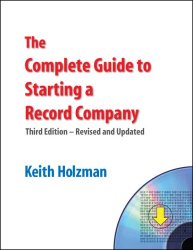
Keith is also the author of the recently published "The Complete
Guide to Starting a Record Company" available both as a 235-page,
printed spiral-bound book, as well as a downloadable E-Book.
|